Jack Kingsman's actual brain

Jack's Brain

Hi! I’m Jack Kingsman, an SRE @ Atlassian in Seattle. In my free time stay busy as an all-around hacker, volunteer EMT, divemaster, and amateur radio operator.

I’ve been playing around a lot with MeshCore, a peer-to-peer, encrypted, routed radio network run by average citizens using LoRa modulation in unlicensed sub-gig bands (902-927MHz ISM band in the US). It’s very similar to Meshtastic, but a lot less chatty (pull-not-push messaging, with conservative advertisement intervals), and thus a lot more reliable at passing messages (although recent Meshtastic firmwares have introduced routing, which helps a bit). The off-grid and encrypted-by-default nature of these networks appeals to my sensibilities, so I’ve been building a few tools while getting my own repeaters set up around town (Remote Terminal for MeshCore, a server + web frontend for serial-connected radios, and a WebGPU bruteforcer library for semi-public hashtag rooms, most concretely – both experiments in development oriented around guiding LLMs as opposed to hand-writing most of the code).

An Uncomfortable Scenario

You’re in a foreign country, and you’ve been mugged1, completely — you’ve got the clothes on your back, and nothing more. Maybe you beg a phone call from someone to get in touch with a loved one to wire you some money. You’ve now got enough to buy a basic phone and use wifi to access Dropbox or Google to get at important papers, password manager data files, credit card numbers to set up contactless/mobile pay, etc.

I love me a typewriter. They’re gorgeous, mechanical works of art. Sadly, they’re loud, and I’m just not as fast on them as a keyboard. So, I made a “Writer Deck,” a subspecies of cyberdeck, the science-fiction-spawned concept of a small, self contained compute device that’s hyper-portable and often kept on one’s person. Writer decks deemphasize general computing and instead focus on distraction-free systems optimized for focused writing and composing. I’ve been writing some more fiction lately, and I’m an easily distractable man (I mean, c’mon, it’s the internet – it’s awesome!). So I made myself one:

Aug 28, 2025

ohai. Been a minute. The brain hasn’t been braining very well lately from a health perspective but we ball.

I’ll do a more full post on it sometime soon, but I’ve been having fun with a Docker-contained VNC honeypot. @Xtrato did something similar but I wanted something that I could blow away easily and that was slightly (as barely as Docker is) more isolated. It’s been a ton of fun watching randos drift through, and it got more fun when I put an nvidia-smi executable that indicates that I have 3xP100s attached to the system hehe. I get about ten connections a day, mostly connect-then-drop, but have seen:

Jun 09, 2025

And boy that came out well 😍😍😍

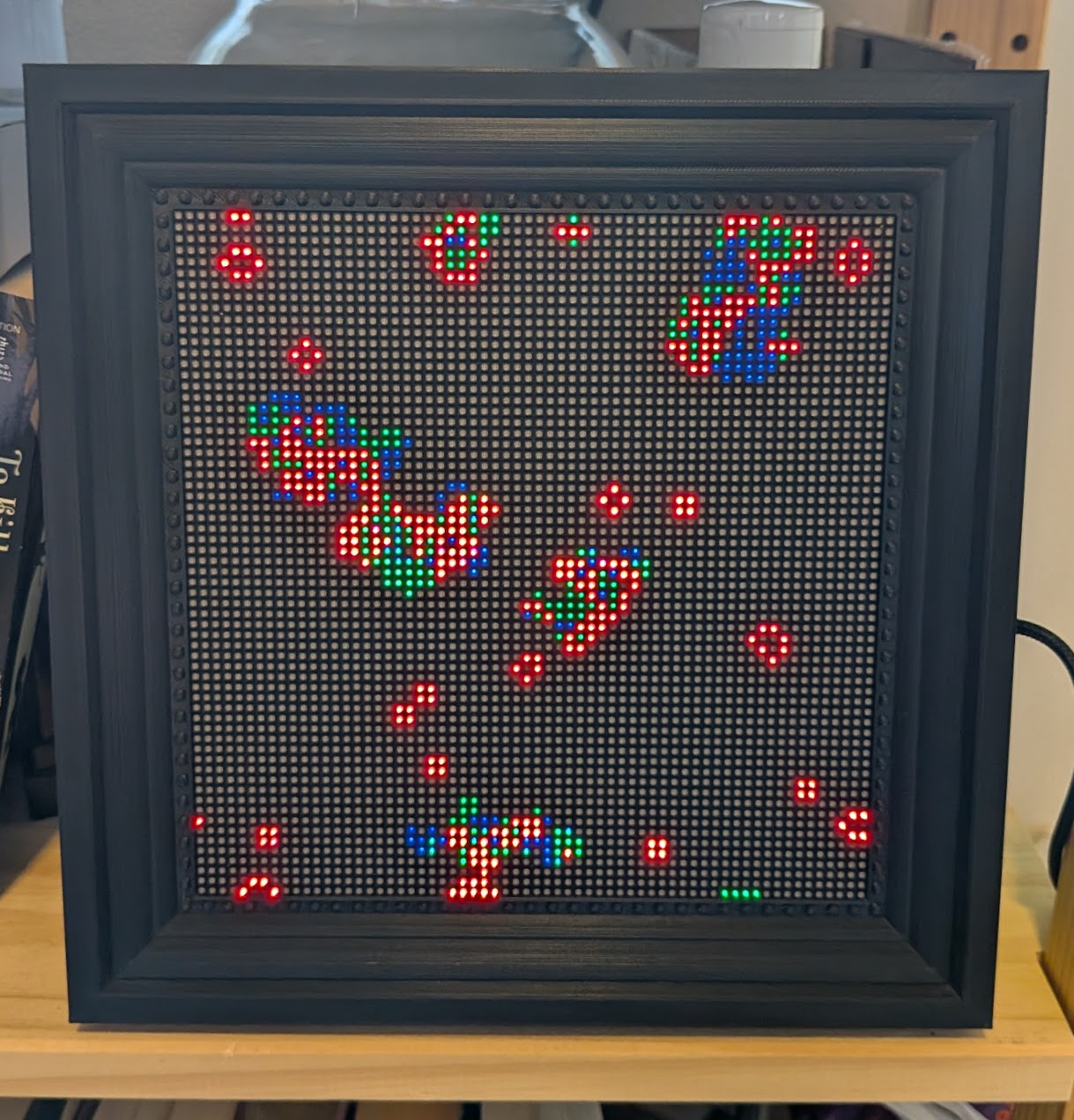
Conway's Game of Life LED matrix with frame

Conway’s Game of Life LED matrix with frame

TL;DR No.

I swore Narrator on Windows XP was saying “pothole,” as in “pothole start” and “pothole menu end” – maybe even something closer to “pothole-p” with a plosive at the end. I finally got fedup and cracked open an XP VM and ResHacker, and sure enough, it’s saying “popup” with the world’s worst diction.

What I heard:

Reality/Proof:

Always wanted to build one of these and now I have!

This is a more frenetic color-demo mode, but my goodness I love it so much. The video doesn’t do the colors justice; they’re so vibrant. Sadly my phone struggles with the refresh rate of the board, but there’s no tearing in person.

This weekend I set out to build a 64x64 LED matrix version of Conway’s Game of Life. For compute’s sake, the board would be wrap-around i.e. on a torus. I wanted each set of generations to run for as long as possible until stagnancy and reset, so I wrote an analysis script to determine what alive-percentage for a random fill would be optimal to keep the game going as long as possible.

I scoured the web for an easy-run RFC865 Cookie/QotD server that I could throw into my Docker host and serve a proper DHCP Option 8 on my home network, but none existed so I vibe coded one. Now, my home network can vibe out like it’s 1983.

Open source as always, I wrote a version that spits out a generic 8-ball fortune (Outlook good, My sources say no, etc.) as well as one that does a classic cowsay | fortune.

Well, turns out this design (an ouroboros twisted to form a Möbius loop, interlocked with two others into Borromean Rings) doesn’t really exist on the internet as far as I can tell. I can find ouroboros as Möbius loop, and I can find ouroboros arranged as Borromean rings, but not all three. For a project I’m doing, I commissioned some!

I didn’t end up using them for what I was planning to, but I am now the rightsholder (as far as I can tell from Fiverr’s ToS? including a commercial add-on where applicable?), so I’m putting them on the web under a Creative Commons CC BY-NC 4.0 license – feel free to use as long as you credit where you got it (me, although I only claim to be the rightsholder and not the original artist) and don’t use it for commercial purposes. Beyond that, what you do with it is your business.

« Older posts